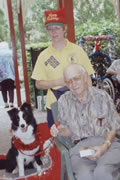
The Volunteers of Pets for Therapy
Due to declining health Yvonne will be retiring, and the Pets For Therapy will cease after 26 years at the end of 2015
You are probably a volunteer by heart already, and if you like to
support our
"Pets for Therapy" program, please read the following
guide lines and contact us.
Do you have an obedience trained dog of good temperament?
Do you have a few hours free?
Would you like to join our happy, friendly group of
volunteers, visiting Nursing Homes, Respite Centers, Special Schools,
etc.?
If you don't have a dog, you still can support us, we always are
in need of people who help with setups, building props, wrapping gifts,
helping with transport, with organisation, fundraising and many more
- please contact us.
Requirements for Volunteers
and to be a member of the team
- The volunteer (handler) and dog must have reached at least
the standard of training required for the Council Certificate of a
trained dog ( i.e. passed post grad ).
They should have preferably trained in a class situation so that both
handler and dog are experienced in working at close quarters with
other dogs and handlers.
(The exception to this rule would be baby puppies ( under 5 months
of age ) with experienced handlers.'
Even then, the puppy must pass the team leaders assessment for temperament
(excitability, fear etc.), bad habits ( e.g.. mouthing,) length of
claws, vocalisation etc.
- All dogs (members) must pass the team leaders assessment
for temperament, cleanliness, claw length, bad habits etc.
- Handlers should understand the risks and the hazards of
dogs in Nursing Homes
- Handlers should be conversant with the benefits of dogs
to Nursing Homes.
- Handlers should be able to control their dog by voice alone,
and in a quiet voice at that, without causing alarm to residents.
- Handlers should be capable of being team players and respect
the team leaders authority, directives and discretion in public.
- THERE should always be the opportunity after every home visit for
debriefing, consensus or disagreement, discussion and planning for
future visits.
This should only take place out of earshot of residents, their families,
carers and staff.
- THERE are standards of dress, grooming and personal presentation
of handlers outlined.
- BEFORE commencing work as a " Pet For Therapy" dog, every
dog should have met and become familiar with all the other members
of the team ( dogs and handlers ) and be stable amongst them.
- All volunteers (handlers) and their dogs must attend Monday afternoon classes as often as is possible.
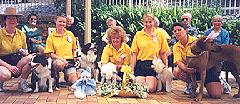
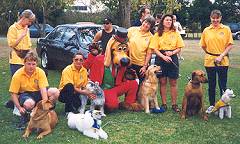
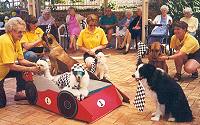
Our past and present Volunteers

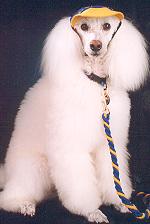
Yvonne Cody
Founder of
"Pets for Therapy" |

Jo Jo
Co-founder of
"Pets for Therapy" |
and Misty |
- Cyn D with pets: BeeCee (F)- Border Collie and Dizzy (M) Retriever C.C.
- Ricki with pets: Pheonix (M) and Asha (F) - Rhodesian Ridgebacks
- Karen with pet: Moet - (M) Miniature Poodle Darcy
- Betty with pet: Susie - Toy Maltese
- Sonja with pet: Ambra - Bichon Frise
- Robyn with pets: Mia(F) and Twiggy (F) - Border Collies
- Leoni with pet: Max A Million (M) - Bichon Frise
- Julianne with pets: Charlie (M) Miniature Poodle and Fergie (F) Toy Poodle and Minx(M) Min.Foxy
- Jeanette & Pappy Pappilon
- Paula, Zak with pets: Gypsy (F) Belgian Shepherd and Baron (M) Swiss Shepherd
- Sue with pet: Lucy (F) – Silver Toy Poodle
- Cavell & Frank with pet: Sunny Boy (M) - Red Toy Poodle
- Peter with pet: Kobi (M) White Toy Poodle
- Yuki with pet: Bobby (M) – chocolate Toy Poodle
- Carolyne with pet: Lady (F) - black Toy Poodle and Porcha (F) black toy Poodle.
- Dorothy with pet: Fluffy ( F) - Apricot Toy Poodle
- Delphine with pet: Cassidy (F) –Black Greyhound
- Grace with pets: Chumuk (M) and Morgan (M) - Malamutes
- Nicole with pet: Rocket (M) - Basenji
- Brennice, Emma & Tiger ( Cairn Terrier X)
- Lisa Maree and her two dogs ( black labrador's ) Kit and Buddy
- Sabina with Amy ( 6 year old female Saluki )
- Cyn-D with Molly (4 year old female Golden Retriever)
- Sabine with Amy ( female Saluki )
- Carolyne with Beau 6 month ( teacup toy poodle ) black
- Steven with Tara 12 year old ( English Staffordshire Terrier )
- Tony with Bruce 6 year old ( Shih Tzu )
- Celeste with Bandit 2 year old ( Border Collie )
- Leni & Boss ( male one year old Old English Sheepdog )
- Terry & Bazil & Bonnie ( male & female Bichon Freze )
- Karen & Nikita ( Russian Shepherd )
- Celeste & Bandit & Koda ( shorhaired border collie & springer spaniel )
- Lilla and Tony & Bruce ( male Shih Tzu )
- Elizabeth and Derek & Tigger ( male Poddle - Bichon X )
- David and Bear, Bobby Jo, Boston, Diesel ( Saint Bernards )
- Chrissi and Turbo and Oscar ( male dachshunds )
- Ruth and Caesar ( male standard Poddle )
- Annette and Cooper ( Silky Terrier X )
- Jenni and Scooby Do ( miniature Collie, Shelty )
- Claire and Zepher ( Poodle Labrador X )
- Jan and Fu-chi ( Chow Chow )
- Louise and Santo ( Golden Retriever Poodle X )
- Mandi and Pluto ( male Toy Poodle )
- Marilyn and Ozzie (male Yorkshire Terrie )
Volunteers without dogs:
- Lilla and Frank
- Justin
- Marguerite
- Delphine
- Susan
- Joanne
- Laural ( Instructor )
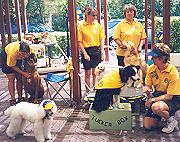 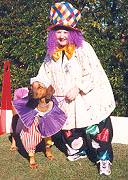 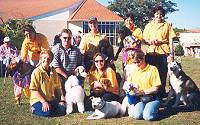
Click pictures below to enlarge
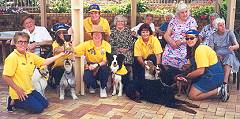 
|
|